

What is an unlisted share price list?
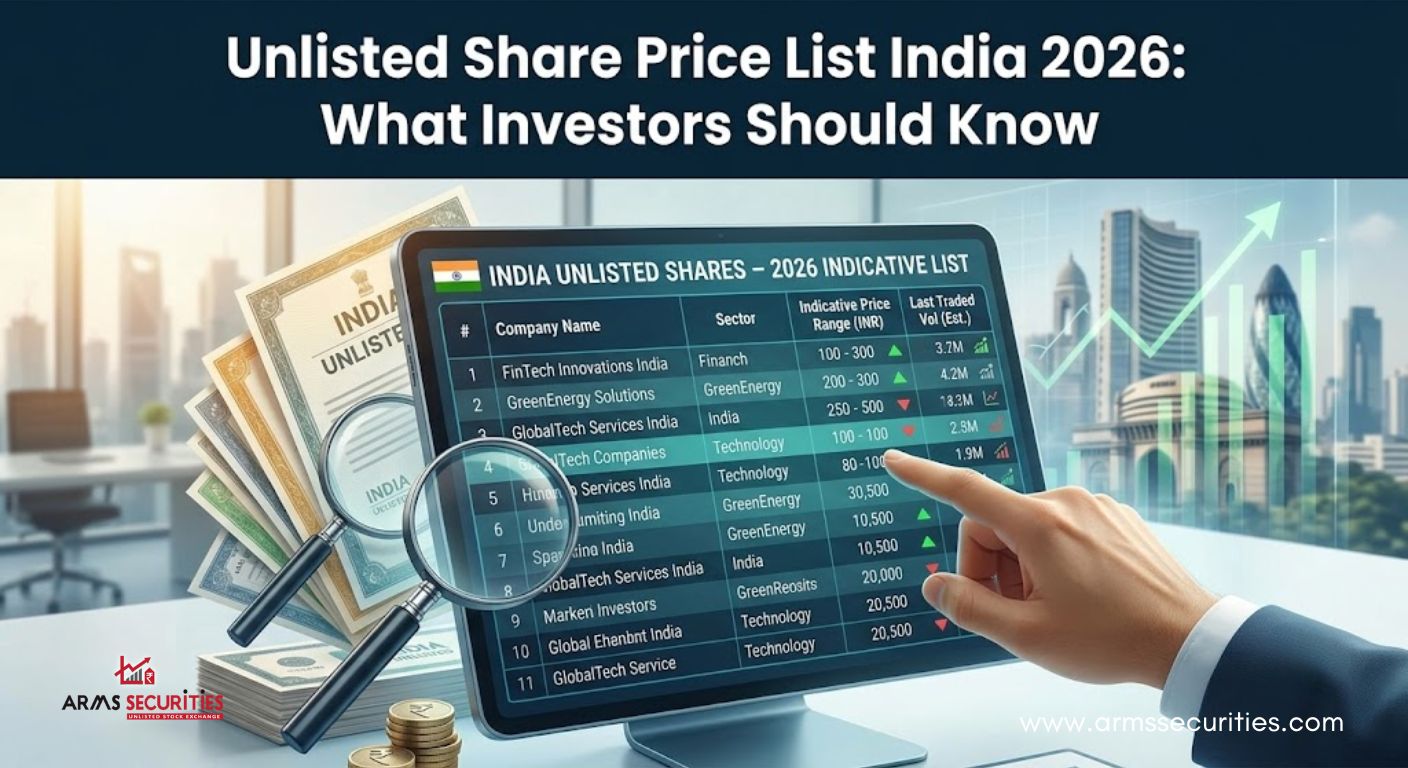
An unlisted share price list in India is a dynamic reference document that displays the indicative buying and selling prices of companies not yet listed on public stock exchanges like the NSE or BSE. Because unlisted shares trade over-the-counter (OTC) rather than through a centralized exchange, these price lists serve as a crucial benchmark for price discovery, helping investors track the latest unlisted share price of high-growth startups, subsidiaries, and pre-IPO companies.
The Indian financial landscape has evolved significantly by 2026. Today, wealth generation isn't just about timing the public markets; it’s increasingly about capturing value before a company goes public. The unlisted shares market India has democratized access to early-stage growth, allowing retail and institutional investors alike to participate in the journeys of tomorrow's market leaders.
However, navigating this space requires specialized knowledge. Unlike the public markets where prices flicker in real-time on a screen, unlisted market pricing is nuanced, OTC-driven, and highly dependent on supply and demand dynamics.
In this comprehensive guide, we will break down exactly how to read, interpret, and utilize an unlisted share price list India, why prices fluctuate, and how you can make informed decisions before you buy sell unlisted shares.
What is an Unlisted Share Price List?
An unlisted share price list is effectively a snapshot of the OTC market at a given point in time. Because unlisted companies are not publicly traded, there is no centralized matching engine pairing buyers and sellers. Instead, transactions are facilitated by specialized wealth management and brokerage firms like Arms Securities.
When you look at an unlisted shares price list 2026, you are looking at indicative prices. These lists aggregate recent transaction data, current market sentiment, and available supply to give you a baseline understanding of what a specific unlisted stock price might be today.
Why the Unlisted Market is Different
In the public market, if a stock is trading at ₹500, you can instantly buy or sell it at (or very near) that exact price. In the unlisted market, a quoted price of ₹500 is a starting point for price discovery. The actual transaction price will depend on the volume of shares you wish to trade, the immediate availability of a counterparty, and broader market conditions.
How Are Unlisted Share Prices Decided in India?
Understanding the mechanics behind a pre IPO share price India is critical for any serious investor. Without a stock exchange to dictate the price, how do these figures end up on a price list?
1. Supply and Demand Dynamics
The most fundamental driver of any unlisted stock price is supply and demand. If a highly anticipated tech company announces its DRHP (Draft Red Herring Prospectus) filing, demand for its unlisted shares usually spikes. If existing employees (holding ESOPs) or early investors aren't willing to sell, this scarcity drives the price up dramatically.
2. Recent Funding Rounds and Valuations
When an unlisted company raises capital from venture capitalists or private equity firms, the valuation of that funding round sets a benchmark. If a company just raised funds at a ₹10,000 crore valuation, the per-share price derived from that valuation often becomes the new baseline on the unlisted share price list India.
3. Financial Performance and Unlocking Value
Unlisted companies still release annual reports. Strong revenue growth, narrowing losses, or hitting profitability milestones will organically push the unlisted share price higher as the intrinsic value of the business grows.
Decoding the Quote: Why Do Buy and Sell Prices Differ?
One of the most common points of confusion for new investors is seeing two different prices for the same stock on a price list. This difference is known as the Bid-Ask Spread.
- The Bid (Sell Price): This is the highest price a buyer is currently willing to pay for the share. If you are looking to sell your holdings, this is roughly the price you will receive.
- The Ask (Buy Price): This is the lowest price a seller is willing to accept. If you are looking to buy shares, this is roughly the price you will pay.
Why Does the Spread Exist?
The spread compensates the intermediaries and market makers who facilitate the trade and take on the risk of holding illiquid assets. In highly liquid unlisted stocks (like a marquee company weeks away from an IPO), the spread between the buy and sell price is usually quite narrow. For obscure or highly illiquid stocks, the spread can be wide to account for the difficulty in finding a matching buyer or seller.
Key Factors Affecting the Latest Unlisted Share Price
When analyzing the unlisted shares market India, you must look beyond the current quote. Several external and internal factors can cause the latest unlisted share price to fluctuate rapidly.
Macro-Economic Conditions
Interest rates, inflation, and global market liquidity directly impact the private markets. In a high-interest-rate environment, capital becomes expensive, and unlisted share prices often contract as investors demand higher risk premiums.
Sector-Specific Tailwinds
If renewable energy is booming in the public markets, unlisted renewable energy companies will see a sympathetic surge in their share prices. The unlisted market often mirrors the sector sentiments of the broader public market.
Proximity to an IPO
The timeline to an Initial Public Offering (IPO) is the ultimate catalyst. As a company moves from rumors, to hiring merchant bankers, to filing the DRHP, and finally getting SEBI approval, the pre IPO share price India generally experiences a steep upward trajectory, often driven by the "Grey Market Premium" (GMP).
Crucial Elements to Watch on a Pre IPO Share Price List
Before executing a trade based on a price list, investors must look for two critical pieces of contextual data.
The Importance of the "Last Updated" Date
The unlisted market is highly volatile. A price list from three weeks ago is essentially ancient history. Corporate announcements, regulatory changes, or sudden macroeconomic shifts can alter prices overnight. Always verify the timestamp on an unlisted shares price list 2026.
Note: At Arms Securities, we strongly advise clients that online price lists are purely indicative. The actual executable price can only be confirmed at the exact moment of the transaction.
Liquidity and Availability Risks
A price list might show a highly attractive price for a fast-growing startup, but that means nothing if the trade size available is zero.
- Low Liquidity: Some shares are tightly held by promoters and early investors. You might see a price, but finding a seller willing to part with the shares is another matter.
- Lot Sizes: Unlisted shares often trade in specific "lot sizes" or minimum investment amounts (e.g., ₹1 Lakh, ₹5 Lakhs). Ensure the lot size aligns with your capital allocation strategy.
Beyond the Price Tag: Why Price Shouldn't Be Your Only Metric
It is a common misconception that buying an unlisted share at a low price guarantees massive returns post-IPO. Relying solely on the latest unlisted share price is a dangerous strategy.
- Valuation vs. Price: A stock priced at ₹50 might be heavily overvalued if the company has billions of outstanding shares and weak revenue. Conversely, a stock priced at ₹5,000 might be cheap if the company has strong fundamentals and a tight equity structure.
- Corporate Governance: Unlike listed companies governed strictly by SEBI's Listing Obligations and Disclosure Requirements (LODR), unlisted companies have fewer reporting requirements. Assess the management team and their track record.
- The Pre-IPO Lock-In: In India, shares acquired before an IPO are subject to a strict lock-in period (currently 6 months from the date of listing for non-promoters). If you buy pre-IPO shares, you cannot sell them on listing day. You must be comfortable holding the asset through the lock-in period, regardless of post-listing market volatility.
Your Checklist Before You Buy or Sell Unlisted Shares
To navigate the unlisted shares market India safely in 2026, follow this strategic checklist before finalizing any transaction:
- Verify the ISIN: Ensure the company has an active International Securities Identification Number (ISIN). Unlisted shares are delivered straight to your demat account; an ISIN is mandatory for this transfer.
- Request Financials: Don't just ask for the price. Ask your wealth manager for the latest Annual Report, balance sheet, and profit/loss statements.
- Confirm the Transaction Costs: Understand the stamp duty, brokerage fees, and any other charges that might eat into your net returns.
- Check the Exact Ticket Size: Confirm the minimum number of shares you are required to buy or sell.
- Assess Your Time Horizon: Ensure the capital you are deploying will not be needed urgently. Unlisted shares are illiquid; exiting your position quickly in an emergency may result in selling at a steep discount.
How Arms Securities Simplifies Price Discovery in the Unlisted Market
The unlisted equity space can feel opaque, but it doesn't have to be. At Arms Securities, we bridge the gap between ambitious investors and high-potential pre-IPO companies.
We understand that an unlisted share price list India is only as good as the execution behind it. Here is how we add value:
- Transparent Price Discovery: We leverage our extensive network of institutional and HNI clients to discover accurate, real-time pricing.
- Seamless Execution: From negotiating the bid-ask spread to ensuring the safe transfer of shares into your NSDL/CDSL demat account, we handle the end-to-end process.
- Research-Backed Insights: We don't just provide quotes; we provide context. Our advisory team helps you understand the underlying business fundamentals behind the price.
Disclaimer: All unlisted share prices found online are indicative. Market dynamics shift rapidly. Please contact the Arms Securities trading desk directly to verify current availability and exact pricing before initiating any transaction.
Frequently Asked Questions (FAQs)
Q1: Can anyone buy unlisted shares in India?
Yes, both resident Indians and Non-Resident Indians (NRIs) can buy unlisted shares, provided they have a valid PAN card, a bank account, and an active Demat account with an Indian depository (NSDL or CDSL).
Q2: Is it legal to buy and sell unlisted shares?
Absolutely. Trading unlisted shares is entirely legal in India. It operates as an Over-The-Counter (OTC) transaction between a willing buyer and a willing seller, facilitated by intermediaries.
Q3: Why did the unlisted stock price of a company drop even though it's growing?
Prices in the unlisted market are heavily driven by liquidity. If a large early investor or a group of employees decides to liquidate a massive block of shares, the sudden influx of supply can temporarily drive the price down, regardless of the company's financial growth.
Q4: How long does it take for unlisted shares to reflect in my Demat account?
Once the payment is completed and the transaction is finalized, the shares are typically transferred to your Demat account within T+1 to T+3 working days, assuming all KYC and documentation are in order.
Q5: Are unlisted share prices guaranteed?
No. Unlisted share prices are indicative and subject to change based on real-time market supply and demand. They are not regulated by an exchange.
Ready to Explore the Private Markets?
The public markets show you what a company is worth today. The private markets allow you to invest in what a company will be worth tomorrow.
If you are ready to diversify your portfolio with high-growth pre-IPO opportunities, don't rely on outdated price lists. Get real-time data, expert research, and seamless execution with Arms Securities.
Contact Arms Securities Today to discuss the latest pre IPO share price India trends and discover which unlisted opportunities align with your wealth-creation goals for 2026 and beyond.
