


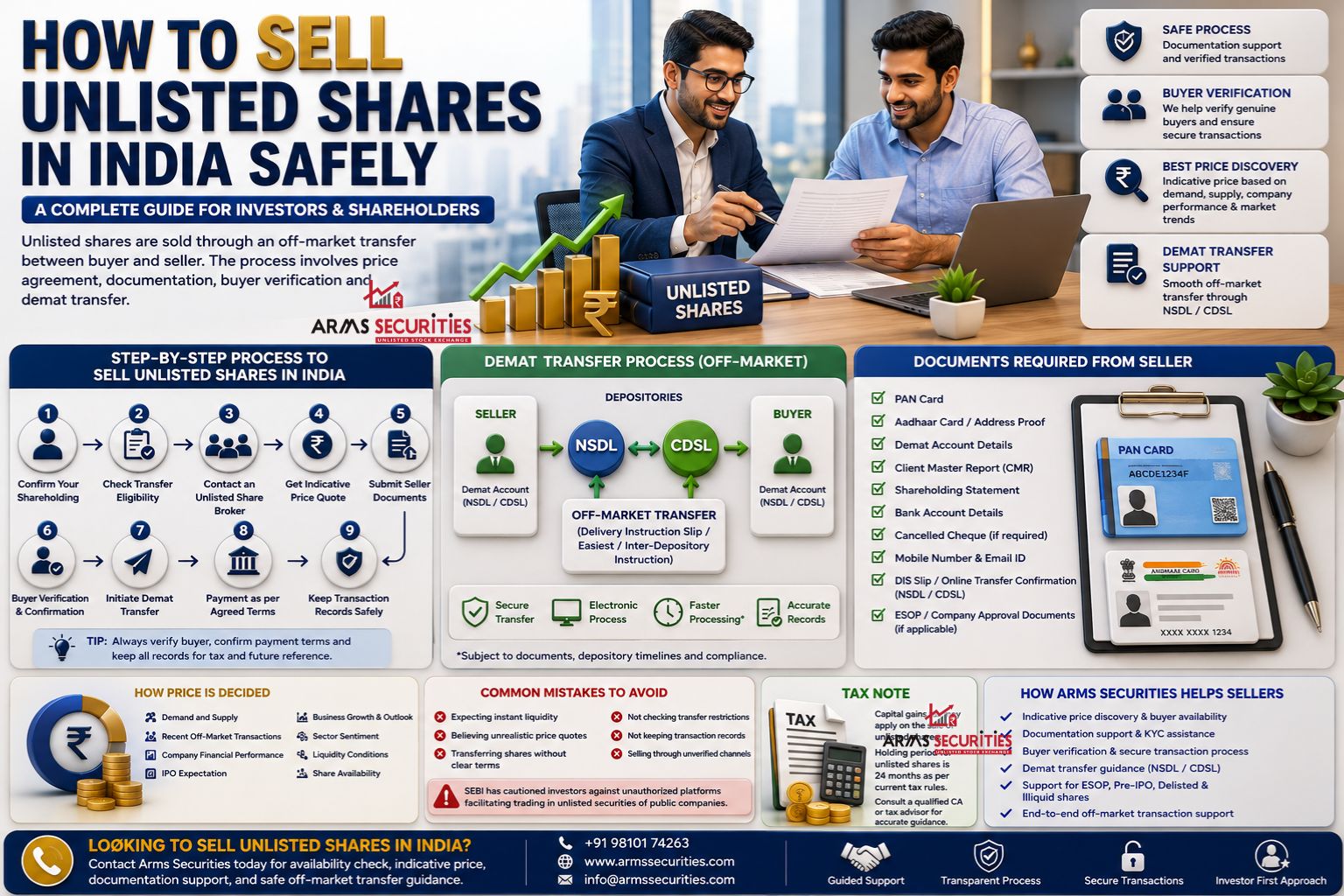
Selling unlisted shares in India is not the same as selling listed shares on NSE or BSE. In listed shares, you can place a sell order through your trading app and the transaction gets settled through the exchange mechanism. However, unlisted shares are usually sold through an off-market share transfer process between buyer and seller.
This is why shareholders, ESOP holders, early investors, and people holding illiquid or delisted shares often need proper guidance before selling. The process involves price discovery, buyer verification, documentation, payment confirmation, and demat transfer.
This guide explains how to sell unlisted shares in India safely, what documents are required, how the demat transfer works, how price is decided, and how Arms Securities helps sellers with a documentation-led and transparent process.
How Can You Sell Unlisted Shares in India?
You can sell unlisted shares in India through an off-market demat transfer, subject to buyer availability, price agreement, documentation, KYC verification, and successful transfer of shares from your demat account to the buyer’s demat account. Since these shares are not exchange-traded, the process requires careful verification and proper transaction records.
What Are Unlisted Shares?
Unlisted shares are shares of companies that are not currently listed on a recognized stock exchange such as NSE or BSE. These may include:
- Pre-IPO shares
- ESOP shares
- Shares of public unlisted companies
- Unquoted shares
- Delisted shares
- Illiquid securities
- Shares of companies with limited market activity
Because they are not traded on an exchange, selling them usually depends on buyer interest, company restrictions, documentation, and market demand.
Why Do Investors Sell Unlisted Shares?
Investors may want to sell unlisted shares for many reasons. Some sellers want liquidity before an IPO. Some ESOP holders want to monetize part of their holdings. Some shareholders may want to exit old illiquid shares or delisted shares.
Common reasons include:
- Need for liquidity
- Portfolio rebalancing
- ESOP monetization
- Exit before IPO
- Tax planning
- Reducing exposure to one company
- Selling inherited or old holdings
- Exiting delisted or illiquid shares
However, sellers should remember that unlisted shares may not have immediate buyers. Therefore, the selling process should be handled with patience and proper documentation.
How Selling Unlisted Shares Works in India
Selling unlisted shares usually happens through an off-market transaction. This means the shares are transferred outside the stock exchange mechanism.
In a typical transaction:
- Seller confirms shareholding and quantity.
- Indicative price is discussed.
- Buyer availability is checked.
- Seller documents are collected.
- Buyer and seller details are verified.
- Payment terms are finalized.
- Shares are transferred through demat.
- Seller receives payment as per agreed terms.
- Both parties keep transaction records.
NSDL states that for off-market transfer of securities, the delivery and receipt instructions need to match for the transfer to be effected from one account to another.
Step-by-Step Process to Sell Unlisted Shares in India
Step 1: Confirm Your Shareholding
Before selling, first confirm that the shares are available in your demat account.
Check:
- Company name
- ISIN
- Quantity
- Demat account number
- Depository: NSDL or CDSL
- Whether shares are free from pledge, lock-in, or restriction
If you hold shares in physical form or inherited form, the process may require additional steps before sale.
Step 2: Check Whether the Shares Are Transferable
Not every unlisted share can be sold freely. Some shares may have company-level restrictions, shareholder agreement restrictions, lock-in conditions, ESOP restrictions, board approval requirements, or transfer limitations.
This is especially important for:
- ESOP shares
- Startup shares
- Pre-IPO shares
- Shares issued under private placement
- Shares under shareholder agreements
- Restricted employee shares
Before committing to any sale, check whether you are allowed to transfer the shares.
Step 3: Contact an Experienced Unlisted Share Broker
Since unlisted shares are not sold through regular exchange trading, sellers often contact an experienced unlisted share broker or intermediary to check buyer demand, indicative pricing, documentation requirements, and transfer process.
Arms Securities assists sellers who want to sell unlisted shares, pre-IPO shares, unquoted shares, delisted shares, and illiquid securities through guided off-market transaction support.
A professional intermediary can help you understand:
- Whether buyers are available
- Current indicative sell price
- Minimum sale quantity
- Documentation required
- Expected transaction timeline
- Demat transfer process
- Risk factors and transfer requirements
Step 4: Get an Indicative Price Quote
Unlisted share prices are not live market prices like NSE or BSE prices. They are indicative and may vary based on demand, supply, availability, recent transactions, company performance, IPO expectation, and market sentiment.
Before selling, ask:
- What is the current indicative sell price?
- Is there active buyer demand?
- What quantity can be sold?
- What is the expected timeline?
- Are there any transfer restrictions?
- Are there charges, taxes, or documentation costs?
Never assume that an online quoted price is the final transaction price. Final execution depends on buyer availability and agreed terms.
Step 5: Submit Seller Documents
Once the indicative price and buyer interest are discussed, the seller may need to provide documents for verification.
Common seller documents include:
| Document | Purpose |
|---|---|
| PAN Card | Tax and identity verification |
| Aadhaar / Address Proof | KYC verification |
| Demat Account Details | Shareholding and transfer confirmation |
| Client Master Report / CMR | Confirms demat account ownership |
| Bank Account Details | Payment settlement |
| Shareholding Statement | Confirms available quantity |
| Mobile Number and Email ID | Communication |
| Cancelled Cheque, if required | Bank verification |
| DIS Slip / Online Transfer Confirmation | Demat transfer |
| ESOP or Company Approval Documents, if applicable | Transfer eligibility |
Documentation may vary depending on the company, buyer requirement, seller profile, and transaction type.
Step 6: Buyer Verification and Transaction Confirmation
Buyer verification is important for seller safety. A genuine transaction should not be based only on verbal communication or informal messages.
Before transferring shares, the seller should confirm:
- Buyer identity or intermediary process
- Agreed price
- Quantity
- Payment terms
- Demat account details
- Transfer timeline
- Tax and record requirements
- Any cancellation or delay condition
This helps avoid confusion later.
Step 7: Initiate Demat Transfer
After confirmation, the seller transfers the shares from their demat account to the buyer’s demat account.
This may happen through:
- Delivery Instruction Slip, also known as DIS
- Online demat transfer facility
- CDSL Easiest facility, where applicable
- NSDL-based delivery instruction process
- Inter-depository transfer if buyer and seller have accounts with different depositories
CDSL’s Easiest facility allows eligible users to transfer securities from one BO account to another demat account, including off-market and inter-depository transactions. NSDL also provides electronic delivery instruction options through its demat gateway ecosystem.
Step 8: Confirm Payment and Keep Records
After the transaction is completed as per agreed terms, the seller should confirm payment receipt and keep all records safely.
Maintain:
- Shareholding proof before sale
- Price confirmation
- Buyer/intermediary communication
- Payment proof
- Demat debit statement
- Bank credit proof
- Tax calculation records
- Any agreement or declaration
These records may be useful for income tax filing, future reference, audit, or dispute resolution.
How Demat Transfer Works While Selling Unlisted Shares
Demat transfer is the core part of selling unlisted shares.
In simple terms:
- Seller holds shares in a demat account.
- Buyer provides demat details.
- Seller submits transfer instruction.
- Depository system processes the transfer.
- Shares move from seller’s demat account to buyer’s demat account.
- Seller receives payment as per agreed terms.
If both buyer and seller are with the same depository, the process may be simpler. If one account is with NSDL and the other is with CDSL, an inter-depository transfer may be required. NSDL describes inter-depository transfer as a process where instructions are exchanged between the two depositories.
How Is the Price of Unlisted Shares Decided?
The price of unlisted shares is based on market demand and availability. Unlike listed shares, there is no real-time exchange price.
The price may depend on:
- Buyer demand
- Seller supply
- Company financial performance
- IPO expectation
- Business growth
- Sector sentiment
- Recent transaction prices
- Valuation compared to listed peers
- Liquidity conditions
- Market news
- Transfer restrictions
This is why the final selling price may differ from prices shown online.
A good seller should not focus only on the highest quoted price. Instead, focus on the credibility of the buyer, documentation process, payment clarity, and transfer safety.
Common Mistakes Sellers Should Avoid
1. Expecting Instant Liquidity
Unlisted shares may take time to sell. Buyer availability is not always guaranteed.
2. Trusting Unrealistic Price Quotes
Very high quotes may not always result in actual execution. Always confirm buyer availability and transaction terms.
3. Transferring Shares Without Clear Terms
Do not initiate demat transfer unless price, quantity, buyer details, and payment terms are clearly agreed.
4. Ignoring Tax Impact
Capital gains tax may apply when you sell unlisted shares. Always consult a CA or tax advisor.
5. Not Checking Transfer Restrictions
Some shares may require company approval or may have transfer restrictions.
6. Not Keeping Transaction Records
Without proper records, tax filing and dispute resolution can become difficult.
7. Selling Through Unverified Channels
SEBI has warned investors about unauthorized electronic platforms facilitating transactions in unlisted securities of public limited companies. The Reuters report on SEBI’s warning noted that such platforms were not recognized or authorized by the regulator for such trading activity.
Tax Note for Sellers of Unlisted Shares
When you sell unlisted shares, capital gains tax may apply. The tax treatment depends on factors such as holding period, purchase price, sale price, transaction date, and your tax profile.
As per government clarification issued after changes in the capital gains tax regime, the holding period for unlisted shares remained 24 months. The Income Tax Department’s guidance also explains short-term capital asset treatment and holding-period rules for different capital assets.
Because tax rules can change and individual cases may differ, sellers should consult a qualified CA or tax advisor before and after selling unlisted shares.
How Arms Securities Helps Sellers
Arms Securities helps shareholders, ESOP holders, and investors who want to sell unlisted shares in India through a structured and documentation-led process.
Why Sellers Prefer Arms Securities
Arms Securities can assist with:
- Indicative price discovery
- Buyer availability check
- Shareholding review
- Documentation support
- Demat transfer guidance
- Off-market transaction coordination
- Seller-side process explanation
- Risk awareness
- Support for illiquid and delisted shares
- Guidance for pre-IPO and unquoted shares
The goal is to help sellers understand the process clearly before proceeding.
FAQs on Selling Unlisted Shares in India
1. Can I sell unlisted shares in India?
Yes, you can sell unlisted shares in India through an off-market transfer, subject to buyer availability, documentation, price agreement, and successful demat transfer.
2. Do I need a demat account to sell unlisted shares?
Yes, if your shares are held electronically, you need a demat account to transfer them to the buyer’s demat account.
3. How long does it take to sell unlisted shares?
The timeline depends on buyer availability, documentation, payment confirmation, and demat transfer processing. It may vary from case to case.
4. How is the selling price decided?
The selling price depends on demand, supply, recent transactions, company financials, liquidity, IPO expectation, and buyer interest.
5. Can ESOP holders sell unlisted shares before IPO?
In some cases, ESOP holders may sell shares before IPO, but this depends on company policy, shareholder agreements, transfer restrictions, approvals, and buyer availability.
6. Are unlisted shares easy to sell?
Not always. Unlisted shares are generally less liquid than listed shares. Selling depends on demand and availability of buyers.
7. What documents are required to sell unlisted shares?
Common documents include PAN, Aadhaar or address proof, demat details, CMR copy, bank details, shareholding statement, payment records, and transfer instructions.
8. Can Arms Securities help me sell delisted or illiquid shares?
Arms Securities can assist sellers with guidance, availability checks, documentation support, and off-market transfer guidance for unlisted, delisted, unquoted, and illiquid shares, subject to market conditions and buyer availability.
Conclusion: Sell Unlisted Shares with Clarity and Documentation
Selling unlisted shares in India requires more care than selling listed shares. Since these shares do not trade on regular stock exchanges, sellers must focus on buyer availability, documentation, demat transfer accuracy, payment terms, and tax records.
A safe selling process should be transparent, well-documented, and realistic about liquidity. Sellers should avoid unrealistic price promises and unverified channels.
Arms Securities assists investors, ESOP holders, and shareholders with guided support for selling unlisted shares, pre-IPO shares, unquoted shares, delisted shares, and illiquid securities.
Want to sell unlisted shares in India?
Contact Arms Securities today to check buyer availability, indicative price, documentation requirements, and off-market demat transfer guidance.
