


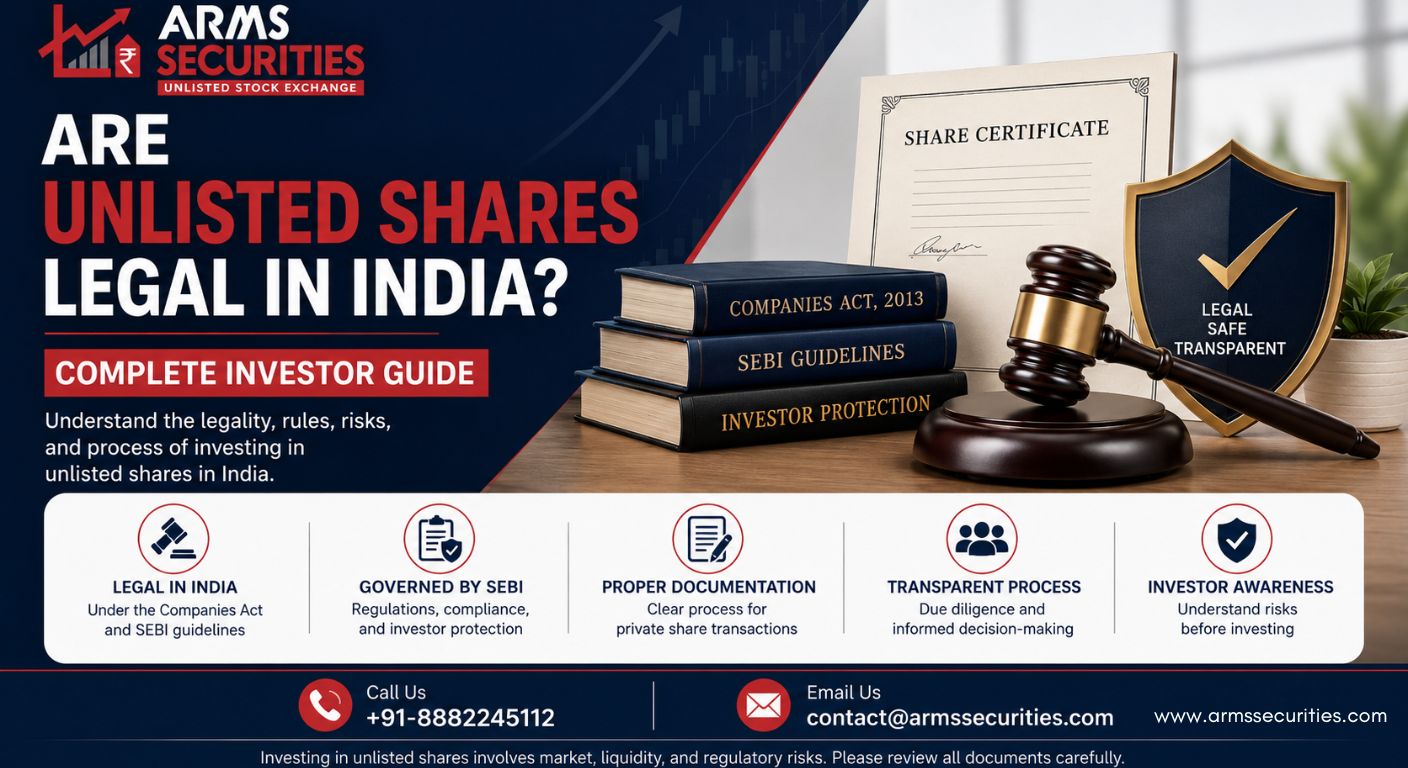
Are unlisted shares legal in India?
Yes. It is completely legal to buy and sell unlisted shares in India. These transactions are governed by the Companies Act, 2013, and operate as legal off-market share transfers between a willing buyer and seller. Because these shares are not publicly traded on exchanges like the NSE or BSE, transactions require careful documentation, active Demat accounts, and adherence to specific regulatory guidelines to ensure you buy unlisted shares legally.
The Indian investment landscape has shifted dramatically over the past decade. Previously, retail investors had to wait for a company's Initial Public Offering (IPO) to participate in its growth story. Today, the private markets have opened up, allowing investors to take stakes in high-growth startups, tech unicorns, and established corporate subsidiaries long before they hit the public bourses.
However, diving into the private market often brings up a critical question for first-time investors: Are unlisted shares legal in India? Because these transactions occur outside the familiar environment of public stock exchanges, they can initially feel opaque. In this comprehensive guide, we will break down the regulatory framework governing unlisted securities India, explain the mechanics of off-market transfers, outline the exact documents you need, and highlight the red flags you must avoid.
What Are Unlisted Shares?
Before examining the legalities, it is essential to understand what the asset class entails. Unlisted shares are simply equity shares of companies that are not listed on recognized public stock exchanges like the National Stock Exchange (NSE) or the Bombay Stock Exchange (BSE).
These can include:
- Pre-IPO Companies: Companies actively preparing to go public in the near future.
- Startups and Unicorns: Fast-growing tech companies backed by venture capital.
- Corporate Subsidiaries: Profitable, unlisted arms of massive, publicly listed conglomerates.
- Employee Stock Ownership Plans (ESOPs): Shares issued to employees who wish to liquidate them before the company goes public.
Since there is no centralized screen flashing real-time prices for these companies, they trade over-the-counter (OTC). This distinction is what often leads investors to question their legality.
The Legal Framework: Are Unlisted Shares Legal in India?
To answer unequivocally: unlisted shares legal India operations are fully supported by corporate law. The buying, holding, and selling of these securities are recognized and regulated under the Companies Act, 2013.
Here is what makes them entirely legal and valid:
Governed by Corporate Law
Unlisted companies are registered with the Ministry of Corporate Affairs (MCA) and the Registrar of Companies (ROC). They are legally bound to hold Annual General Meetings (AGMs), file annual financial returns, and maintain proper books of accounts. When you buy shares in these entities, you become a legal shareholder with recognized rights.
Foreign Exchange Management Act (FEMA) Compliance
Non-Resident Indians (NRIs) can also participate in the unlisted space. The Reserve Bank of India (RBI), under FEMA guidelines, permits NRIs to invest in unlisted Indian companies, subject to specific pricing guidelines and reporting requirements.
Pre IPO Shares Legal India: The Lock-In Rule
If you are buying shares specifically because a company is nearing its IPO, you must be aware of the lock-in regulations formulated by the Securities and Exchange Board of India (SEBI). Once an unlisted company successfully lists on the stock exchange, shares acquired before the IPO are typically subject to a strict 6-month lock-in period for non-promoters. This means you cannot sell your pre-IPO shares on listing day; you must hold them for six months post-listing. This rule is a legal mechanism to prevent sudden, massive sell-offs that could crash the newly listed stock's price.
The Mechanics: How Legal Off-Market Share Transfer Works
If you cannot buy these shares on your standard trading app by clicking a button, how does the transaction occur? The process is known as an off-market share transfer.
Unlike on-market trades, which are executed through the exchange's clearinghouse, an off-market transfer happens directly between the buyer's Demat account and the seller's Demat account.
Here is how the legal flow operates:
- Price Discovery: A buyer and seller agree on a specific price and quantity. This is usually facilitated by intermediaries who match the parties.
- Payment Execution: The buyer transfers the funds directly to the seller (or through a secure, designated banking channel arranged by an intermediary).
- Delivery Instruction Slip (DIS): The seller submits a signed DIS to their Depository Participant (DP), instructing them to transfer the exact number of shares to the buyer's Demat account.
- Stamp Duty: In India, off-market transfers of unlisted shares attract a stamp duty (currently 0.015% of the transaction value), which must be paid legally to validate the transfer.
The Vital Role of Demat Accounts in Unlisted Securities India
Gone are the days of physical, paper share certificates. To buy unlisted shares legally today, you must hold them in a dematerialized format.
The Ministry of Corporate Affairs (MCA) has mandated that unlisted public companies must issue securities only in dematerialized form. This was a massive regulatory step to ensure transparency, prevent fraud, and make the demat transfer unlisted shares process seamless.
Unlisted shares are held in the exact same Demat accounts (via CDSL or NSDL) as your regular listed stocks. Every legitimate unlisted company will have an active International Securities Identification Number (ISIN). If an entity claims to sell you unlisted shares but cannot provide an ISIN for demat transfer, walk away immediately.
What Investors Should Verify Before Buying
While the asset class is legal, the OTC nature of the market means investors must conduct their own strict due diligence. Do not rely blindly on a broker's pitch.
Here is a checklist to ensure you are engaging in a safe, legal transaction:
- Verify the ISIN: Check the 12-digit alphanumeric code assigned to the company's shares to ensure they are eligible for electronic transfer.
- Review Financial Statements: Request the latest Annual Report, Profit & Loss statement, and Balance Sheet. Unlisted companies are required to file these with the ROC.
- Understand the Equity Structure: Check the total number of outstanding shares to understand the company's true valuation, not just the per-share price.
- Assess the Intermediary: Ensure the firm facilitating the trade has a clean track record, transparent processes, and clear communication.
- Confirm Tax Implications: Unlisted shares are subject to different capital gains tax rules than listed shares. Long-term capital gains (LTCG) apply after holding the asset for 24 months (compared to 12 months for listed equities).
Legal Transaction Support vs. Risky Unauthorized Platforms
The unlisted market has seen a surge in participation, which unfortunately attracts unauthorized operators. Understanding the difference between a supportive intermediary and a risky platform is crucial to protect your capital.
| Feature | Professional Transaction Support | Risky Unauthorized Platforms |
|---|---|---|
| Pricing | Transparent bid-ask spreads based on market supply and demand. | "Guaranteed" low prices that seem too good to be true. |
| Share Delivery | Shares transferred directly to your NSDL/CDSL Demat account. | Promises of "holding shares on your behalf" or paper certificates. |
| Payment Channels | Clear, auditable bank transfers aligned with KYC documents. | Requests for cash payments, cryptocurrency, or obscure third-party apps. |
| Documentation | Provides transaction notes, stamp duty receipts, and clear audit trails. | Refuses to provide written confirmation or rushes the process. |
| Information | Provides factual annual reports and highlights market risks. | Promises "guaranteed returns" post-IPO. |
Red Flags to Avoid
If you encounter any of the following while trying to buy unlisted shares, consider them severe red flags:
- Pressure Tactics: Creating false urgency (e.g., "This price is only valid for the next hour").
- No Demat Requirement: If a seller says you do not need a Demat account to buy their shares, it is highly likely a scam.
- Unregistered Entities: Avoid dealing with anonymous individuals on social media or messaging apps offering massive discounts on pre-IPO shares.
Documents Required to Buy Unlisted Shares Legally
To ensure full compliance with Indian financial regulations, you will need to prepare specific documents before initiating an off-market trade. This strict Know Your Customer (KYC) process protects both the buyer and the seller.
- Client Master Report (CMR): A crucial document provided by your Depository Participant (your broker) containing your Demat account details, bank mapping, and holding type.
- PAN Card Copy: Mandatory for all financial transactions in India.
- Aadhar Card Copy: For address and identity verification.
- Cancelled Cheque: To verify the bank account linked to your Demat account.
- Non-Disclosure Agreement (NDA): Sometimes required by the unlisted company to protect sensitive corporate information shared during due diligence.
How Arms Securities Supports Your Journey
Navigating the complexities of unlisted securities India requires a reliable partner who prioritizes transparency, rigorous process adherence, and client education. At Arms Securities, we are dedicated to demystifying the private markets for our clients.
We do not believe in opaque transactions. Instead, we offer:
- Assisted Off-Market Transaction Support: We help bridge the gap between verified buyers and sellers, ensuring that price discovery is fair and transparent.
- Demat Transfer Guidance: Moving shares OTC can be technically daunting. Our team guides you through the entire demat transfer unlisted shares process, ensuring the correct forms are filed and ISINs are verified.
- Documentation Assistance: From helping you procure your CMR copy to ensuring stamp duties are accurately calculated and paid, we handle the heavy lifting of the legal paperwork.
- Investor Education: We prioritize your understanding of the market. We provide access to corporate financial reports, explain pre-IPO lock-in rules, and outline the risks and rewards of the unlisted space.
Investing in tomorrow's market leaders should be an exciting journey, not a stressful administrative hurdle.
Frequently Asked Questions (FAQs)
Q1: Is there a minimum investment amount required for unlisted shares?
Unlike the public market where you can buy a single share of a company, unlisted shares often trade in predefined "lot sizes" (e.g., blocks of 100 or 500 shares) or require a minimum ticket size (e.g., ₹50,000 to ₹1 Lakh), depending on the specific company and seller availability.
Q2: Do I need a special type of Demat account for unlisted shares?
No. Your standard Demat account held with NSDL or CDSL (which you use for listed stocks) is fully capable of holding unlisted shares, provided the unlisted company has an active ISIN.
Q3: How are unlisted shares taxed in India?
Unlisted shares are taxed differently than listed ones. Short-Term Capital Gains (holding less than 24 months) are taxed according to your applicable income tax slab rate. Long-Term Capital Gains (holding more than 24 months) are taxed at 12.5% (as per recent updates, always consult your tax advisor for the latest fiscal year rules).
Q4: Can NRIs invest in unlisted shares legally?
Yes, NRIs can legally purchase unlisted shares under FEMA guidelines on a non-repatriation or repatriation basis, usually requiring an NRO or NRE bank account linked to their Demat account.
Q5: What happens if the company never goes public (IPO)?
An IPO is never guaranteed. If a company does not go public, you can still hold the shares and benefit from potential dividends, or you can sell them via an off-market transfer to another willing buyer, provided there is demand for the stock.
Secure Your Position in the Private Market
Understanding that unlisted shares legal India operations are safe, regulated, and entirely accessible is the first step toward diversifying your wealth portfolio. While the potential for high returns in the pre-IPO space is attractive, it requires patience, due diligence, and the right procedural support.
Do not let the complexities of off-market transfers keep you from accessing early-stage growth opportunities.
Visit Arms Securities today to access our investor education resources, receive demat transfer guidance, and get professional assisted off-market transaction support for your next unlisted investment.
Disclaimer: The information provided in this article is for educational and informational purposes only and does not constitute financial, legal, or tax advice. Unlisted shares are highly illiquid and carry a higher risk profile than listed securities. Prices are indicative and subject to market forces. Arms Securities acts strictly as an intermediary providing assisted off-market transaction support and documentation assistance. We strongly recommend consulting with a certified financial planner or tax advisor before making any investment decisions in the unlisted market.
